
- Published on 05 Nov 2026
The US Midterms Are Done: What the Results Could Mean for Your Money
America has just voted in its midterm elections, and the results are in. You might be wondering why an election on the other side of the world matters to you. The short answer is that many Australians own US shares without realising it, usually through their super fund.
In this article, we break down what happened, how markets reacted and why something called a "data centre" is suddenly part of the conversation. It draws on recent analysis from Russell Investments, explained in everyday language.
What happened?
The Democrats have won control of both houses of the US Congress. Meanwhile, President Trump, a Republican, remains in the White House until 2028.
This creates what's known as a "divided government". Think of it like a household where one partner holds the credit card and the other has to sign off on every big purchase. Big changes become much harder to agree on, so things tend to stay roughly as they are.
How did the markets react?
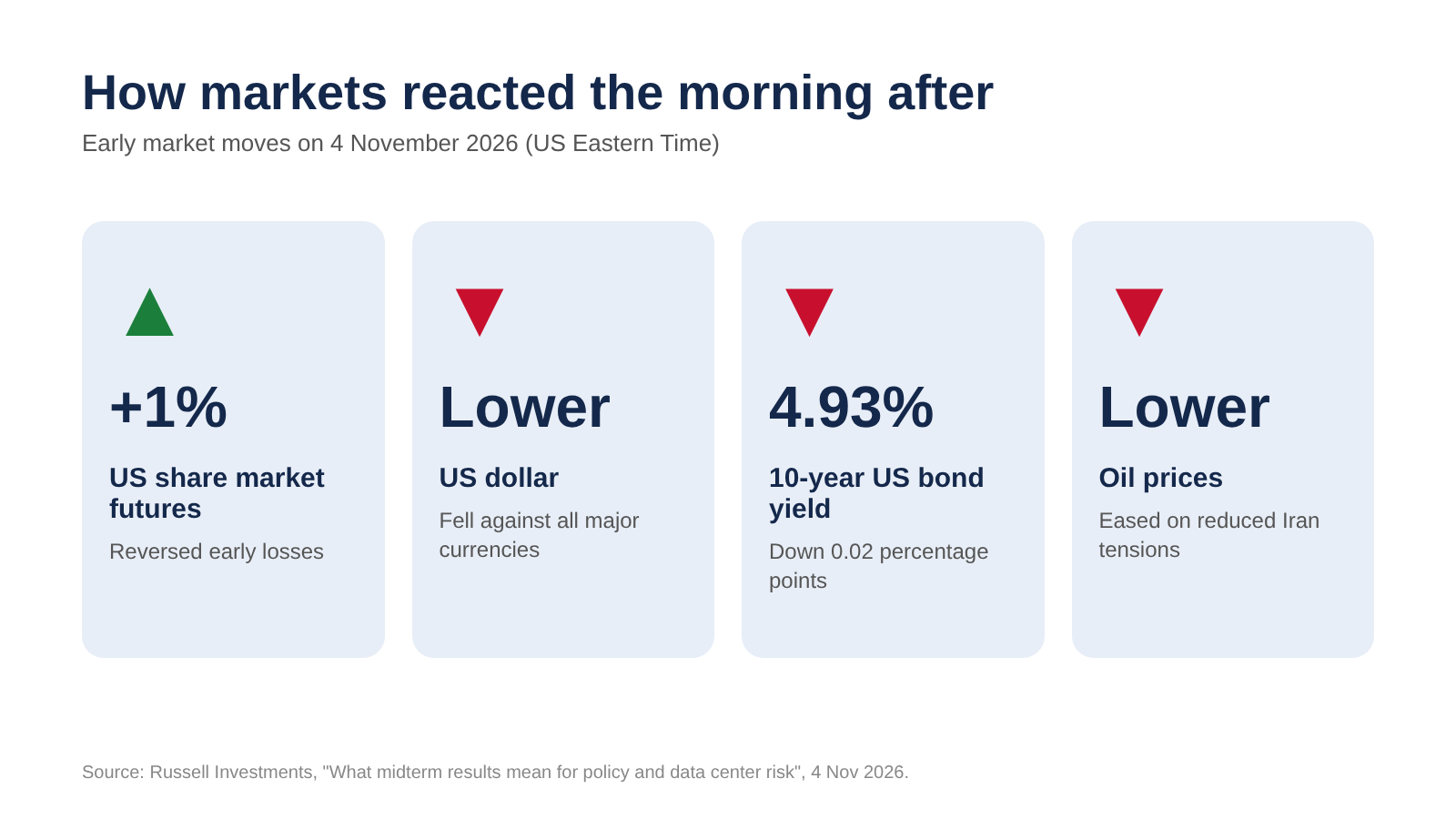
Investors generally prefer certainty, and once the results became clearer, markets rose. US share market futures turned early losses into gains of around 1%. The US dollar also fell against other major currencies.
Interest rates on US government bonds dipped slightly as well. Russell suggests investors expect less government spending and borrowing, because a split Congress makes large new spending plans harder to pass. It's also worth knowing that, historically, markets have often risen in the period after US midterm elections.
Less room for big spending
Even with more seats, the Democrats don't have enough votes to overrule a presidential veto. That means sweeping new laws are unlikely in the next two years. Instead, we may see more debate over budgets, including the President's proposed US$1.5 trillion defence budget.
Russell expects company profits to stay healthy and doesn't see a big short-term effect on economic growth or inflation. Questions about future company tax rates may come up later. However, it's far too early to guess what happens after the 2028 presidential election.
Why data centres are suddenly in the spotlight
This is the part of the story most people won't hear on the evening news. Data centres are huge buildings packed with computers that power the internet and artificial intelligence (AI). They use a lot of electricity and water, and some communities worry this pushes up their household bills.
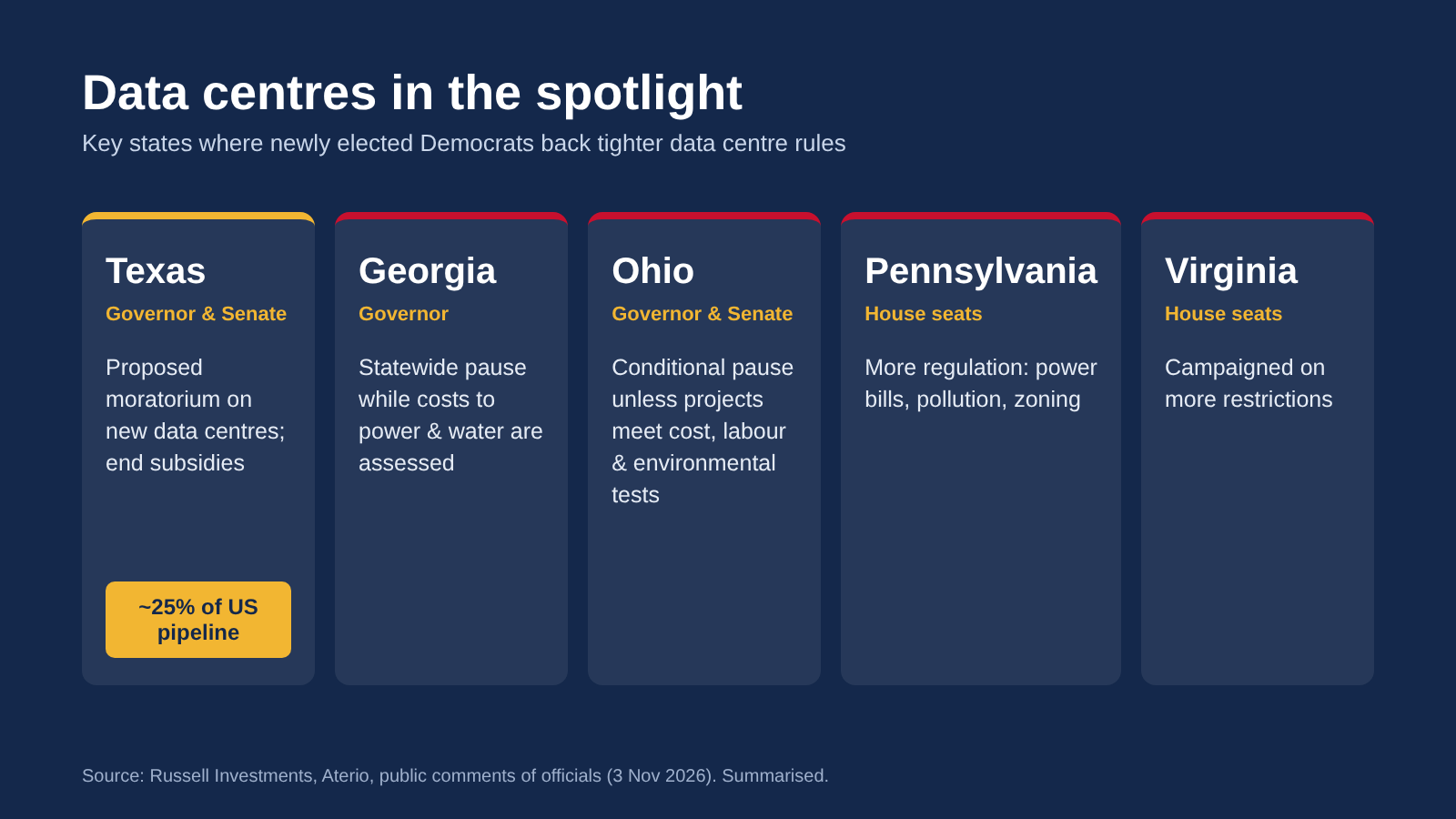
For the first time since 1987, Democrats will lead Texas, Georgia and Ohio as governors. All three incoming governors have backed ideas to pause or restrict new data centre construction. Texas alone accounts for roughly a quarter of planned US data centre projects, so any changes there could be significant.
Who could be affected?
If data centre projects slow down or cost more to build, the effects can ripple outwards. Companies in construction, electrical equipment, air conditioning, utilities and computer chips could all feel it. Some of these suppliers are based in Asia, closer to home than you might expect.
Many of the world's largest companies are investing heavily in AI right now. If building their infrastructure becomes slower or more expensive, it could affect their spending plans and, eventually, their profits. That's why investors will be watching closely.
What to keep an eye on in 2027
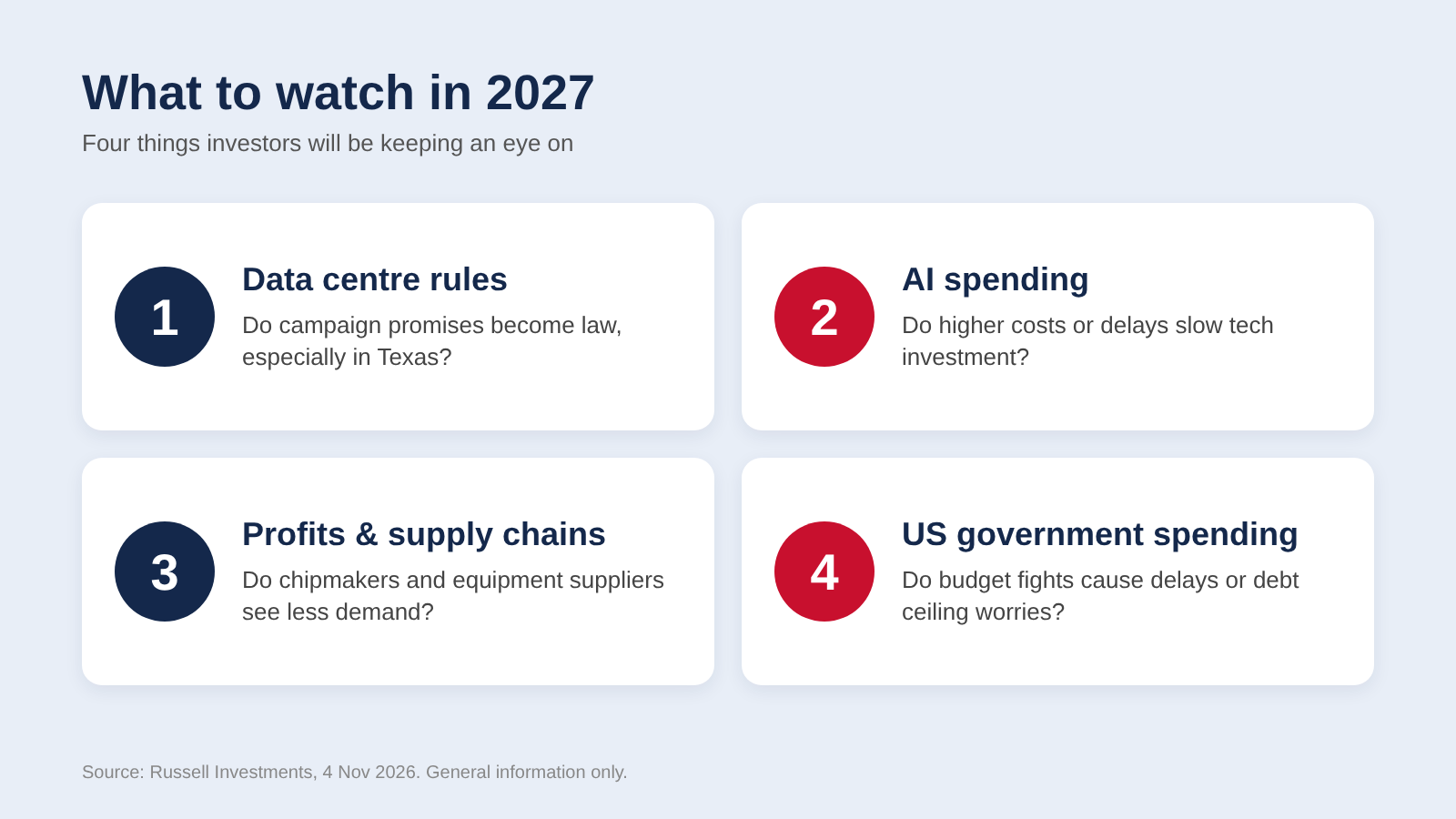
Russell highlights a few things to watch over the coming year:
- Data centre rules: whether campaign promises actually become law, especially in Texas.
- AI spending: whether higher costs or delays slow down investment in technology.
- Company profits and supply chains: whether chipmakers and equipment suppliers see less demand.
- US government spending: whether budget disputes cause delays or debt ceiling worries.
The bottom line
Russell Investments says the election result isn't a reason to change its overall market outlook. The global economy remains resilient and company profits are strong. The main new risk to watch is around the AI building boom, rather than the wider economy.
For most long-term investors, headlines like these are worth understanding but rarely worth reacting to. A well-diversified portfolio is designed to ride through political ups and downs. If you'd like to talk about how global events affect your super or investments, our team is always happy to have a chat.
Source: Paul Eitelman, "What midterm results mean for policy and data center risk", Russell Investments, 4 November 2026. Views reflect conditions as at the time of publication.
General advice warning: This article contains general information only and does not take into account your personal objectives, financial situation or needs. Before making any financial decision, consider whether it is appropriate for you and seek personal advice.