
- Published on 18 Aug 2026
- - What is Financial Planning?
The scam websites ASIC pulled down last year rose 182%. AI is the reason
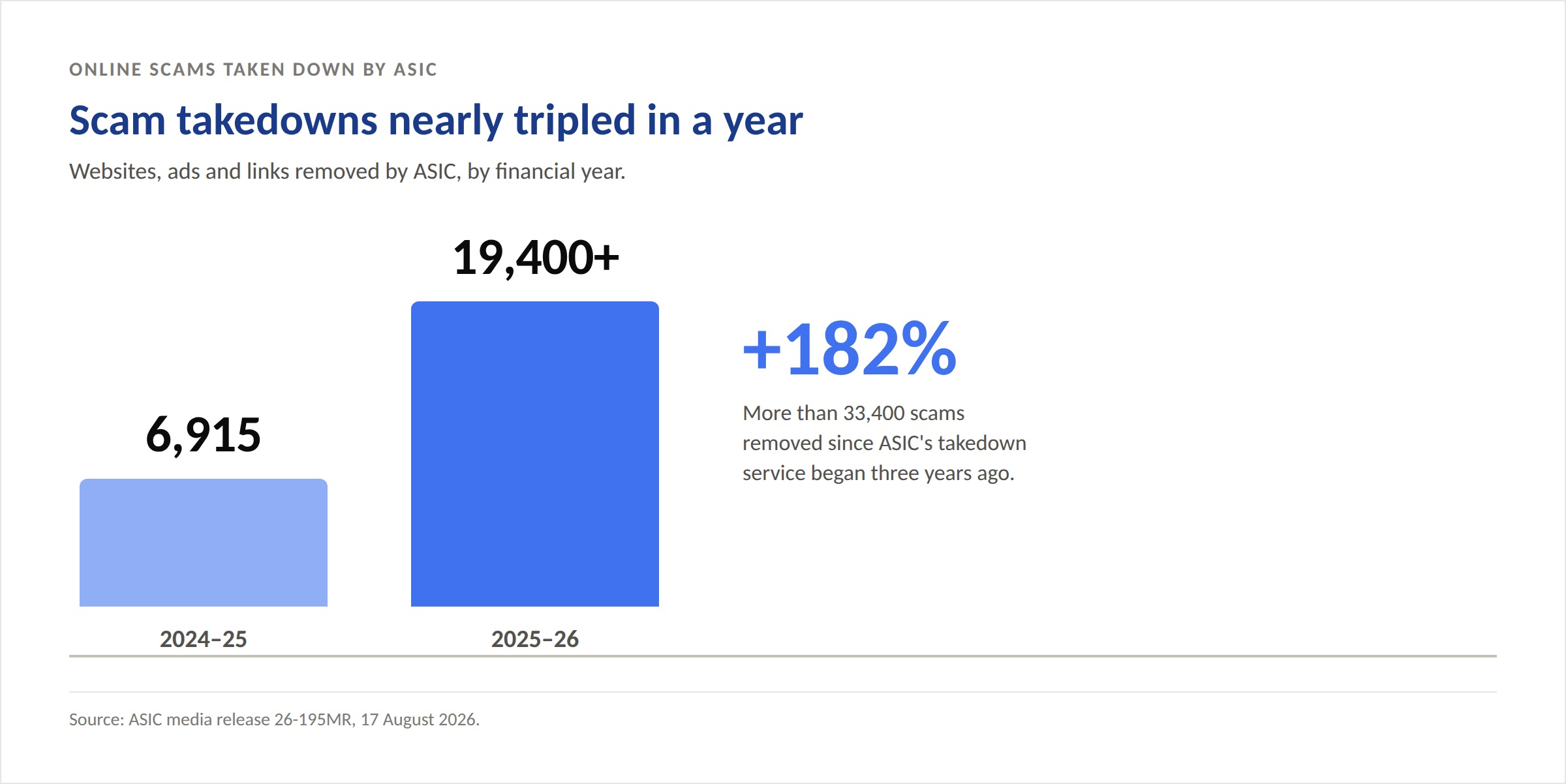
Australia's corporate regulator removed more than 19,400 scam websites, social media ads and phishing links in the 2025–26 financial year — up 182% on the 6,915 it took down the year before. The Australian Securities and Investments Commission says artificial intelligence is doing most of the heavy lifting for the criminals behind them.
That warning, issued on 17 August 2026, came less than a month after the Australian Federal Police made much the same point on 23 July: organised crime networks are using AI to build investment frauds that are, to the naked eye, indistinguishable from the real thing.
The people losing money are not careless. They are, increasingly, older Australians with decades of disciplined saving behind them.
The numbers
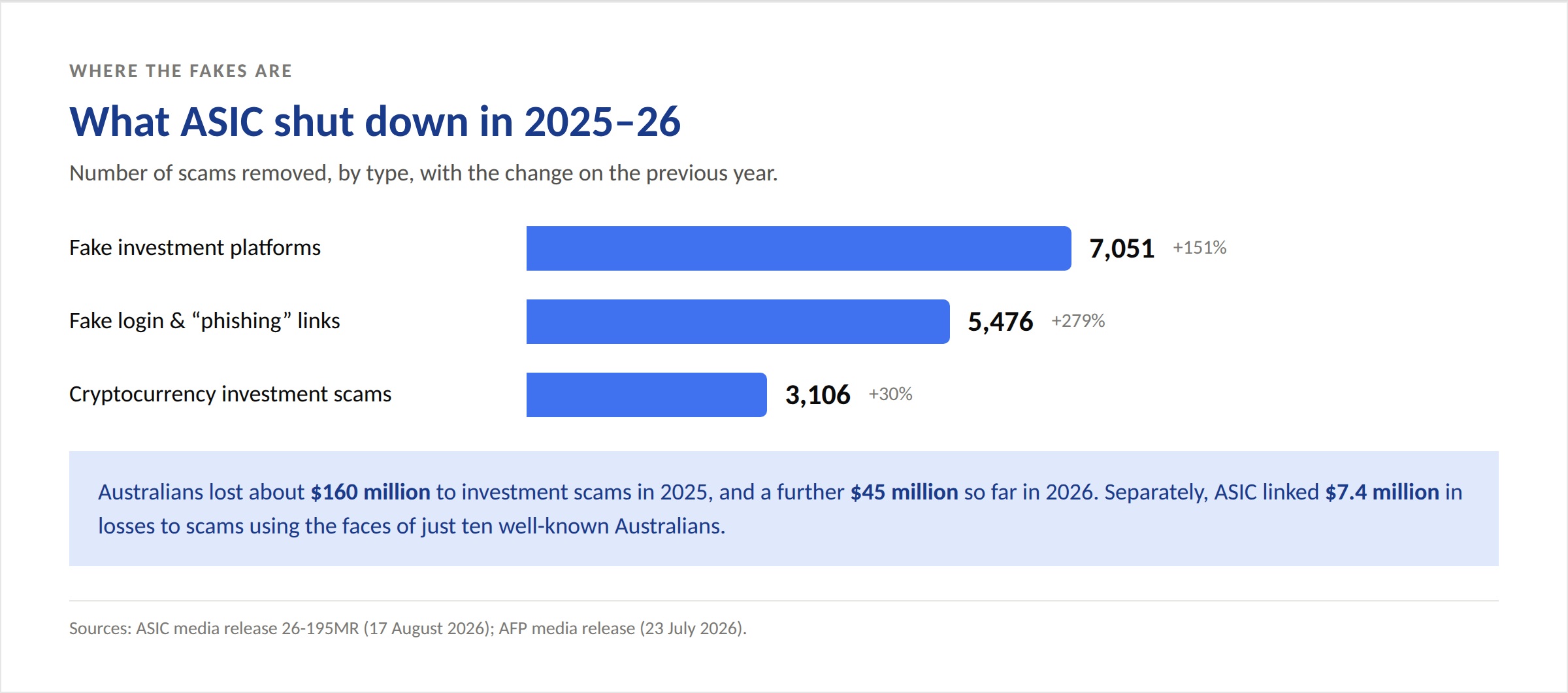
Fake investment platforms were the single largest category in ASIC's takedowns, at 7,051 — a 151% increase. Phishing pages built to harvest login details rose 279%, to 5,476. Cryptocurrency investment scams accounted for another 3,106, up almost 30%. Across three years, ASIC has now removed 33,400 scam assets.
The AFP puts the cost at more than $160 million lost to investment scams in 2025, with a further $45 million already gone in the first half of 2026. Both figures count only the losses that were reported.
Why the old advice no longer works
For years, consumers were told to watch for spelling mistakes, clumsy design and dodgy-looking websites. That test is now close to useless.
Generative AI can produce a polished trading platform, twelve months of fabricated performance charts, several hundred five-star reviews and a run of realistic news coverage in an afternoon. It can also produce video of recognisable Australians appearing to endorse products they have never heard of.
ASIC's list of the ten most impersonated public figures in 2025–26 reads like a Sky Business run sheet: Prime Minister Anthony Albanese, market commentators Tom Piotrowski and Alan Kohler, economists Stephen Koukoulas and Alan Oster, and business figures Dick Smith and Gina Rinehart, among others. Scamwatch reports link those impersonations to $7.4 million in losses.
"AI is making investment scams more convincing and harder to detect", ASIC chair Sarah Court said. "A simple online search is not enough to verify whether an opportunity is legitimate." Polished content, familiar branding and convincing testimonials, she added, are not evidence that an investment is real.
Who is being targeted
The AFP describes the typical victim as a first-time or inexperienced investor, weighted towards people over 60, with a roughly even split between men and women. Many are at or near retirement.
The case studies are blunt.
- A 29-year-old Queensland man lost more than $166,000 through a fake cryptocurrency trading app, after downloading a mobile application and a browser extension and watching fabricated profits accumulate before his money was moved out.
- A Queensland woman lost $107,000 over more than a year, groomed by people posing as investment advisers across phone calls, WhatsApp messages and video meetings that began with a Facebook ad.
- Another Queensland man in his twenties lost $160,000 in a single day.
- A woman in her sixties lost more than $100,000, including her superannuation.
"Where criminals see vulnerability and opportunity, they won't hesitate to exploit it", Detective Superintendent Marie Andersson said.
The superannuation angle deserves attention
Notice what the $107,000 case has in common with several others: at some point, the victim was persuaded to roll her superannuation into a self-managed fund.
That step is the point of the exercise. An APRA-regulated fund sits behind a licensed trustee, prudential supervision and — if something goes wrong — access to the Australian Financial Complaints Authority and, in defined circumstances, the Compensation Scheme of Last Resort. Move the money into a [self-managed super fund](https://www.yourlifetime.com.au/services/582/self-managed-superannuation) and you become the trustee. The legal responsibility for every decision, including the decision to send money to a fraudster, sits with you, and the consumer protections that apply to APRA-regulated funds largely do not follow you across.
SMSFs are a legitimate and, for the right circumstances, excellent structure. But the decision to establish one should never originate with someone who contacted you first — least of all through a social media advertisement.
If restructuring your superannuation comes up during an unsolicited investment pitch, treat it as the warning sign, not the opportunity.
What to look for
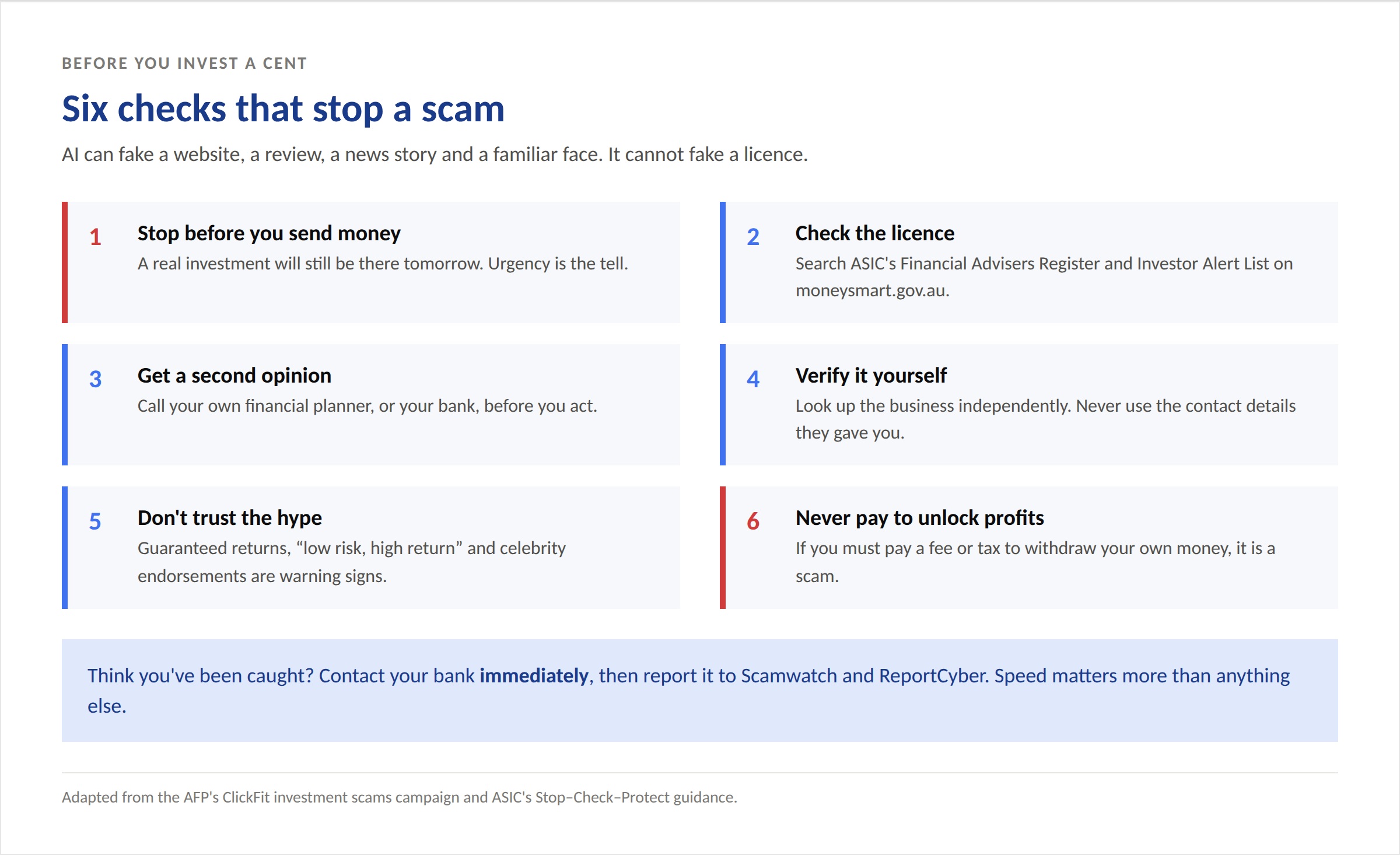
Urgency is the clearest tell. Legitimate investments do not evaporate overnight, and no genuine business needs your decision by close of business.
Be equally sceptical of guaranteed returns, "low risk, high return" framing, celebrity endorsements encountered on social media, and anyone who discourages you from seeking a second opinion.
One more catches people late in the process: if you are asked to pay a fee, a tax or a "release charge" before you can withdraw your own profits, it is a scam. Real investments do not require additional payments to release your money.
The two-minute check
Before any money moves, search the business on ASIC's Investor Alert List, which names entities operating without a licence in Australia.
Then confirm that whoever you are dealing with appears on ASIC's Financial Advisers Register on the Moneysmart website. If they are not on it, stop.
Look the business up independently every time. Never use the phone number, link or email address the other party supplied — scammers are perfectly happy to give you contact details for their colleagues.
Make one phone call first
The most effective protection available is a conversation with someone who knows your circumstances and has nothing to gain from the transaction.
If you are already a client, speak to your LifeTime Financial Group planner before acting on any investment opportunity that arrived unsolicited. There is no such thing as a silly question here. We would much rather spend ten minutes on a false alarm than an afternoon on a real loss.
If you do not have an adviser, use the Moneysmart Financial Advisers Register to check that anyone you are considering is properly registered. Our guide on how to find a good financial planner covers what else to look for, and you can meet our team here.
If you think you have been caught
Contact your bank immediately. Speed matters more than anything else you do. Then report it to Scamwatch and to police through ReportCyber.
The AFP makes a point worth repeating: many victims never come forward because they are embarrassed. These operations are run by organised criminal networks using tools purpose-built to fool careful, intelligent people. Being targeted is not a failure of judgement — and silence only protects the people who did it.
Take the next step
Why not take the next step and talk to a qualified and highly experienced financial planner today? LifeTime Financial Group are specialist (holding appropriate accreditations) financial planners, ideally positioned to work with you in planning and managing your financial planning needs.
If you would like to discuss your current position or wider financial planning needs, call us today on 03 9596 7733. There is no cost or obligation for our initial conversation.
LifeTime Financial Group. A leading privately owned Melbourne-based financial planning practice with no ties to any financial institution.
*This article contains general information only and does not take into account your objectives, financial situation or needs. Consider whether it is appropriate to your circumstances and obtain personal advice before acting on it.*
**Sources:** ASIC media release 26-195MR, 17 August 2026; AFP media release, 23 July 2026.