
- Published on 09 Jul 2026
- - What is Financial Planning?, Investment & Financial Advice
Choosing a financial planner is one of the most consequential money decisions you will ever make, yet most Australians spend more time researching a new car. The reassuring news is that you do not need insider knowledge to do this well. Australia has free, public tools that let you verify almost everything that matters before you hand over a single dollar.
Anyone Can Sound Like an Expert. Not Everyone Can Legally Advise You.
The words “financial planner” only mean something when they sit behind a licence. To give you personal advice on investments, superannuation or life insurance, an adviser must appear on ASIC’s Financial Advisers Register. If they are not on it, they cannot legally provide that advice. That single check removes most of the risk before you have even had a conversation. Look up the register rather than relying on a statement from the person you are meeting, or worse still, a sticker on their window.
Start With the Register, Not the Google Reviews
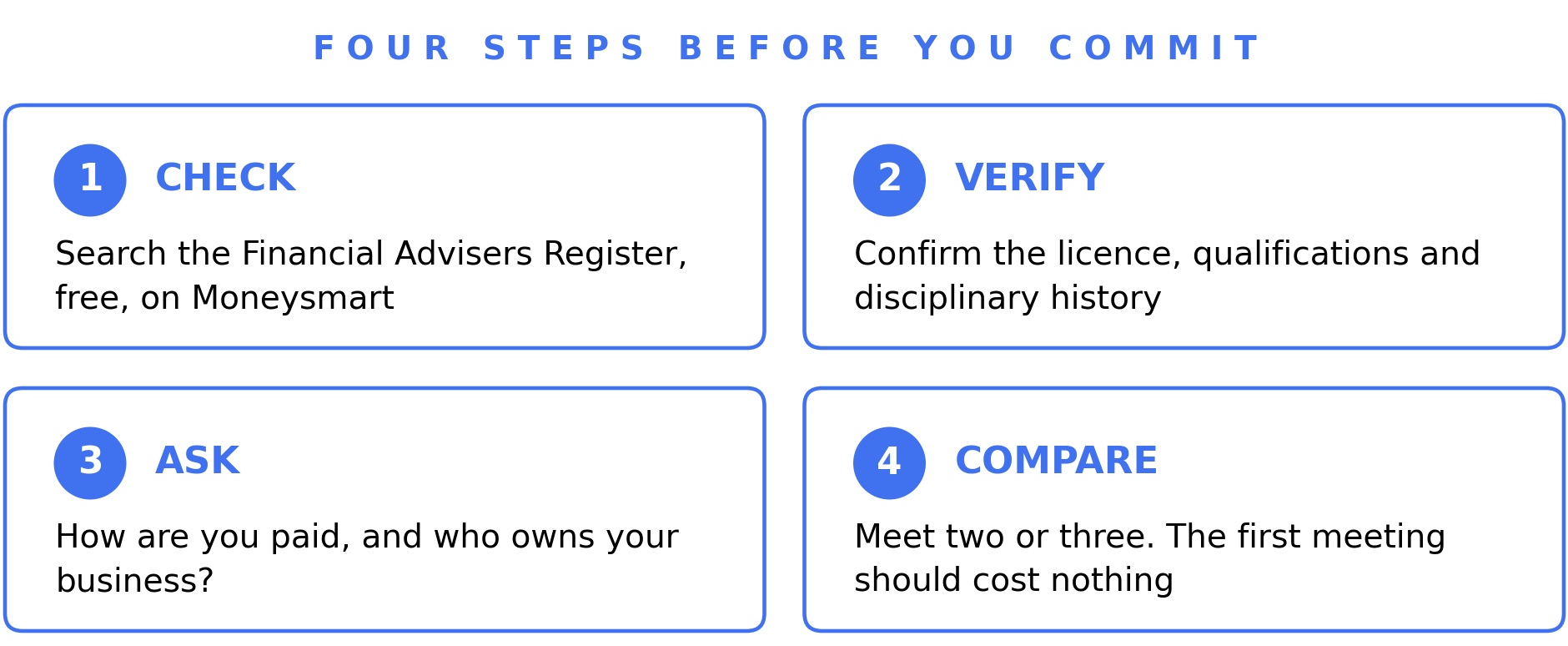
The Financial Advisers Register is managed by ASIC and published free on the Moneysmart website. Search by name, adviser number or business name, and you will see their licensee, their qualifications, the products they are authorised to advise on, their employment history, and any disciplinary action or failure to meet annual training requirements. See links below
Two caveats are worth knowing. Only individuals appear on the register, not companies, so search the person rather than the practice. And ASIC does not audit the entries before publishing them — the licensee is legally responsible for accuracy. Treat the register as your starting point, not your whole investigation.
Qualifications: What the Letters Actually Mean
Every adviser must now meet minimum education and ongoing professional development standards, so a degree is a floor rather than a differentiator. Look instead for the Certified Financial Planner (CFP) designation, the highest certification awarded by the Financial Advice Association Australia (FAAA). If your situation is specialised — self-managed super, aged care, a divorce settlement — ask for evidence of accreditation in that specific field.
One point of confusion worth clearing up: the Financial Planning Association (FPA) no longer exists. It merged with the Association of Financial Advisers in April 2023 to form the FAAA. Older articles pointing you to “the FPA” are describing the same body under a different name, and its Find a Planner tool now sits on the FAAA website.
Our principal, Anthony Stedman is both CFP qualified, A Fellow of the FAAA and is a specailist accredited SMSF Adviser. Ted (Jiayi) Liao also hold the CFP designation
Follow the Money
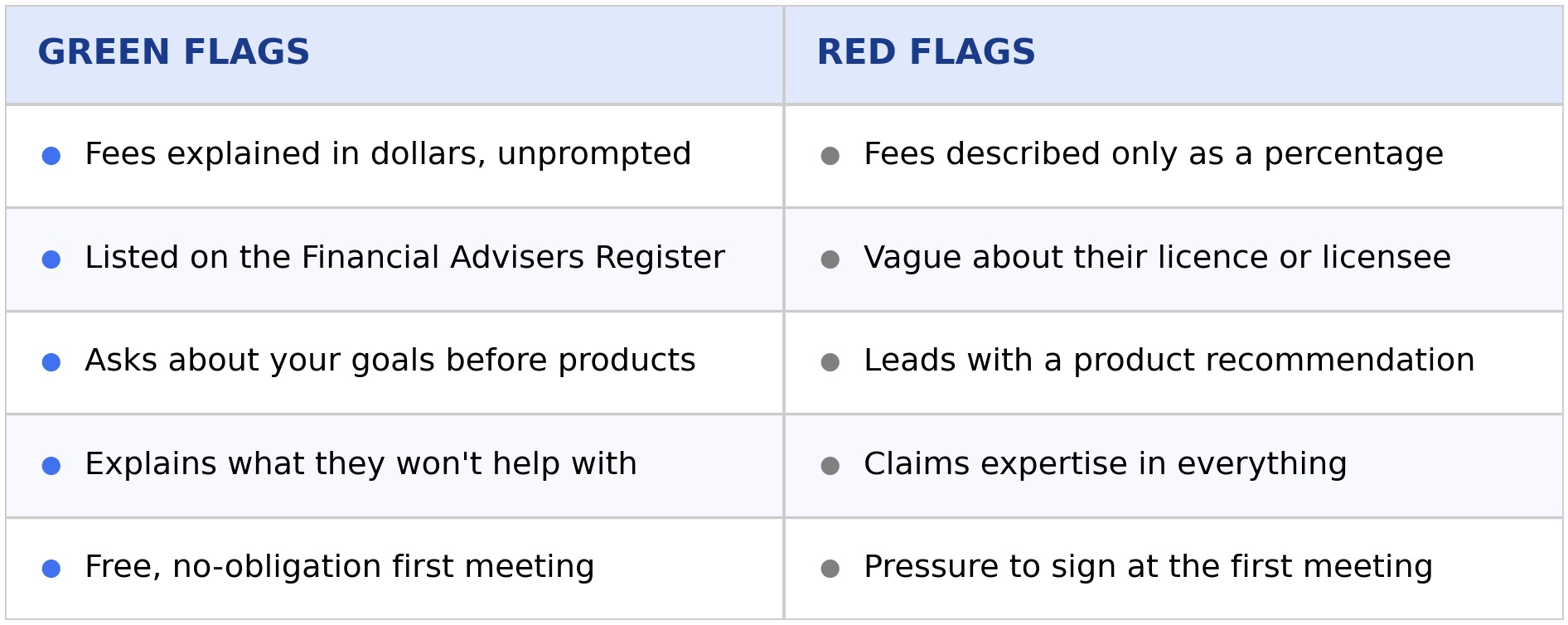
Ask exactly how your planner is paid, in dollars, before the second meeting. Fees may be charged as a flat annual amount, an hourly rate, or a percentage of the assets under management — and each structure creates a different incentive. A percentage-based fee, for example, grows quietly as your balance grows.
None of these arrangements is inherently wrong. What matters is that the number is disclosed clearly, in writing, and that you understand what you receive for it. For a fuller breakdown, see our article on what a reasonable fee for a financial adviser looks like.
The Ownership Question Most People Forget to Ask
Ask who owns the practice. Advisers employed by, or aligned with, a bank, insurer or fund manager may be restricted to an approved list of products — often including products issued by the parent company. Privately owned practices with no institutional ties do not face that constraint.
This does not automatically make one better than the other. It does mean you should know which you are dealing with, because it shapes the range of options you will ever be shown.
Green Flags and Red Flags
Five Questions for Your First Meeting
- Are you on the Financial Advisers Register, and what is your adviser number?
- What will I pay in year one, in dollars, and what will I pay every year after that?
- Who owns your business, and are you limited to an approved product list?
- What are your qualifications, and which professional body are you a member of?
- If I am unhappy with your advice, who do I complain to?
On that last question, the answer should be the Australian Financial Complaints Authority (AFCA). Any adviser who hesitates on it is telling you something useful.
The Bottom Line
Verify the licence, understand the fee, ask who owns the business, and meet more than one planner before you commit. A good adviser will welcome every one of those questions. If you are still working out what you actually need help with, our overview of what financial planning involves is a sensible place to begin.
Take the Next Step
Why not take the next step and talk to a qualified and highly experienced financial planner today? LifeTime Financial Group are specialist (holding appropriate accreditations) financial planners who are ideally positioned to work with you in planning and managing your financial planning needs.
If you would like to discuss your current position or wider financial planning needs, why not call us today on 03 9596-7733? There is no cost or obligation for our initial conversation/meeting.
LifeTime Financial Group. A leading privately owned Melbourne-based Financial Planning practice with no ties to any financial institution.
This article provides general information only and does not take your personal objectives, financial situation, or needs into account. It is not personal financial advice. Tax rates, caps, and rules are current as at the 2025–26 financial year and may change. You should seek advice tailored to your own circumstances before acting.
References
ASIC Moneysmart — Financial advisers register: moneysmart.gov.au/financial-advice/financial-advisers-register
ASIC — Financial Advisers Register (regulatory overview): asic.gov.au/regulatory-resources/financial-services/financial-advice/financial-advisers-register
Financial Advice Association Australia — Who is the FAAA: faaa.au/who-is-the-faaa
ASIC Moneysmart — Financial advice: moneysmart.gov.au/financial-advice